Periodically we get emails from users having problems with the activation. So we put together a check list on how to deal with the most frequent issues. In case these fixes do not help you solve your problem, please contact contact support at support@componentowl.com and we will be happy to help you out.
Below, you will find some obstacles we have stumbled across in the past.
- Try to rebuild the project/solution
- Restart Visual Studio if rebuilding the solution did not stop the nag screen
- If you use Better ListView in a Class Library project, it should be referenced and activated in both, the main project and the Class Library project.
- Do the main project (executable) and all referenced projects contain the licenses.licx file within the Properties folder? If not, rebuild the main project (executable) and copy the licenses.licx file to the appropriate location in all referenced projects (Class Library or other executables).
- The licenses.licx file should contain only a single reference to Better ListView with the current version number (e.g. ComponentOwl.BetterListView.BetterListView, BetterListView, Version=3.7.2.0, Culture=neutral, PublicKeyToken=e6c91a3add447be2). If there are more lines referencing Better ListView, remove the obsolete ones. You can also delete the licenses.licx file and rebuild the project to regenerate it.
- Run the Activator application (installed along with the product) and check if it displays a valid license (license info should be displayed in green).
- You can try to finish the activation via the Activator app and then rebuild the main project. The Activator allows custom proxy settings for activation from behind a web proxy (often present in corporate environments).
- Check, if the license-blv.dat file is present in the “C:\ProgramData\Component Owl\” folder after activation. If not, please contact support at support@componentowl.com
- Check, if your projects reference the same version of Better ListView as the one that is installed. Open the „Reference Properties“ window by right clicking on Better ListView reference in the Solution Explorer. Then check if there is a Specific Version property set to true. If so, remove the reference and add a new reference to Better ListView with the correct version. You can also just set Specific Version property to false.
- The Better ListView has to be activated on each machine where it is built. Do not copy the license-blv.dat file because this is specific to each machine. Rather follow the activation process on each machine.
We hope these clues can help you, in case you encounter a problem during the activation. As mentioned before, please contact support, if the issues persist.
]]>When evaluating an alternative to replace the .NET ListView you might stumble upon the question: what sets the different solutions available apart from each other? Which one meets my demands the best?
Here are the three main reasons we think Better ListView is the ideal solution for you if you are planning to use a professional alternative:
1) The intuitive approach on getting started
The good thing is, you can get started right away. Due to the build-up of processes, as well as the well documented procedures you have almost no learning period. Component Owl keeps its design close to the original .NET ListView so you do not have to get acquainted to a completely new system. But still, the changes made are substantial enough to make your working routine so much easier. Whether its the inbuilt drag & drop, the sub-item images or the multi-column sorting, the processes are meant to make your life easier.
2) The fast and helpful support
As Component Owl has been on the market for quite a while now, it has been further developed and improved countless times, resulting in a detailed and meaningful FAQ which answer to the majority of your questions. In case you cannot find the answer you need, you can rely on our support system which will give you feedback on you request within 24 hours. This allows you to keep the workflow going with almost no interruptions and puts you ahead of the freeware users.
3) The possibility to customize
Just like every developer has his own style of working, Component Owl can be customized to every user needs. The many opportunities to adapt your surface to your favorite design or to arrange the necessary tools the way you need them, allows you to optimize your workflow to perform even better.
These 3 named advantages are just a few of the many that Component Owl offers you. For more infromation just check out our trial version to see for yourself.
]]>Today, our blog post covers an interesting case when using Internet Explorer.
When instantiating an ActiveX control written as a .NET assembly exposed via Interop you might get the following message:
System.IO.FileNotFoundException("Could not load file or assembly 'BetterListView, Version=3.8.2.0, Culture=neutral, PublicKeyToken=xxxxxxxxxxxxxxxx' or one of its dependencies. The system cannot find the file specified.")
The solution to this problem is a fairly simple one, quoting from an MSDN article:
“… you can install it in the global assembly cache so that it can be activated from any COM client. If the assembly is only going to be activated by a single application, you can place it in that application’s directory.”
Concluding from this short excerpt, you are basically left you with two options:
1) You may register BetterListView in GAC if it is to be shared. But you should be careful with GAC because it allows holding multiple versions of the same assembly. You can make the installer remove any older versions from GAC during installation and add/keep just the newest one.
2) You can put your .net assembly with all third-party DLLs in one directory during installation if it is to be private.
We recommend the second solution as we reckon it to be the safer one.
]]>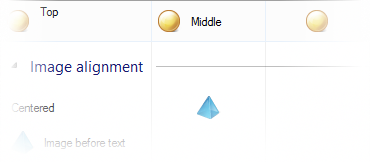
Centered images in Better ListView
Better ListView 3.11 supports aligning images in sub-items and columns to center. Simply set AlignHorizontalImage property of an sub-item or column to BetterListViewImageAlignmentHorizontal.OverlayCenter.
The image will be centered inside available space regardless of text.
This is useful for sub-items and column headers consisting of image only.
]]>
Better ListView Sub-item Check Boxes
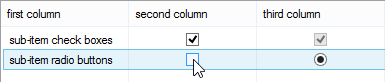
Better ListView 3.10.0 allows displaying fully interactive check boxes and even radio buttons in sub-item cells.
This feature can be activated simply by setting CheckBoxAppearance property of a given sub-item to other value than Hide. Such sub-item will not display check box or radio instead of image and text.
Please note the first sub-item’s properties do not apply as they are overriden by item’s properties. These two are separate for the case of column reordering (keeping consistency of sub-item states).
Another new feature in Better ListView is that check boxes or radios can be displayed disabled. This can be achieved by setting CheckEnabled property to false on the respective item or sub-item.
Sub-item check boxes can be operated by both mouse and keyboard. Checking sub-item with keyboard can be done by navigating focus rectangle by arrow keys to the given sub-item and pressing spacebar.
]]>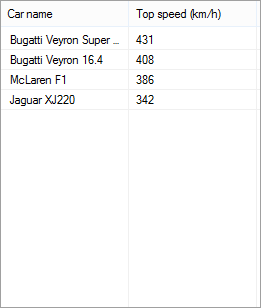
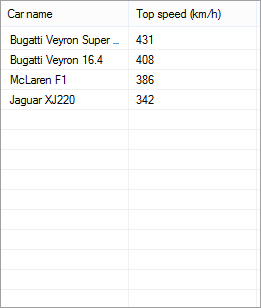
Default list without grid lines below items